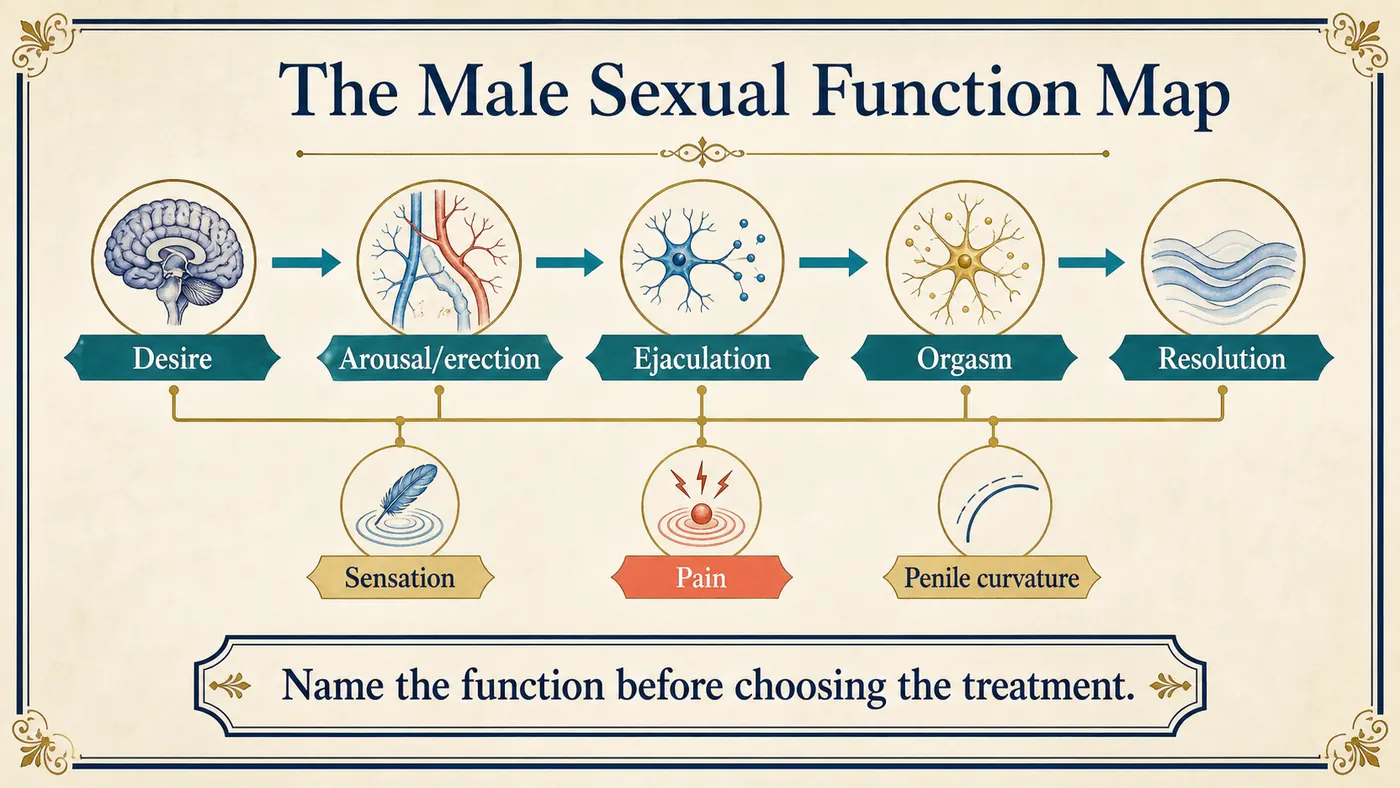
Key points
- Climaxing too quickly, taking too long, orgasm without semen and a bending erection are four different problems, not versions of ED.
- A change in one sexual function does not always mean a problem in the others.
- The goal may be fertility, comfort, pleasure, dryness or restoring semen release, and each leads to a different plan.
- Medication and surgery timelines often solve part of the puzzle.
- Curvature is judged by function, including pain, instability and whether penetration is possible, not by angle alone.
- A new painful bend needs assessment; supplements should not delay it.
Sexual function is not one switch
Sexual function is a coordinated sequence: desire, erection, ejaculation, orgasm, sensation and the shape of the penis. These are connected, but a change in one does not always mean there is a problem in the others. Many men say “sex is not working” simply because they have never been given the words to separate the stages. Finding those words is often the most useful first step, and many men feel immediate relief when they learn that orgasm can remain intact without ejaculation, that a medication may explain delayed climax, or that curvature is a structural problem rather than a failure of arousal.
Four men, four different problems
One man climaxes too quickly. Another takes an unusually long time or never reaches orgasm. A third has an orgasm but releases no semen. A fourth has an erection that bends painfully. These are not four versions of erectile dysfunction, and they do not share one treatment.
- Climaxing too quickly is judged by timing, limited control, distress and the relationship context, not by comparison with pornography or an arbitrary ideal. It may have been present all along or may have developed later.
- Delayed or absent ejaculation can come from medications, neurologic disease, diabetes, pelvic surgery, hormonal conditions, reduced sensation, psychological factors, or stimulation that does not match a learned response.
- Orgasm without semen may mean semen is traveling backward into the bladder (retrograde ejaculation), often because the bladder neck does not close as expected. A dry orgasm may also follow prostate surgery or reflect an absence of semen release.
- A bending erection may be Peyronie’s disease, scar tissue in the covering of the penis, or a curve that has been present since birth, which is a different situation.
What to tell your clinician
Say exactly what changed and when it began. Note whether there is pain or a firm area you can feel. Explain how the change affects sex or causes distress, for you and, if involved, your partner. Bring your full medication list and any history of prostate or pelvic procedures. The more precisely the function is named, the more precisely the cause can be found.
The medication and procedure timeline
Antidepressants, prostate medications, antipsychotics, opioids and other drugs can alter desire, semen release, ejaculation, sensation or orgasm. The effect may begin soon after a medication change or appear so gradually that the connection is missed. Stopping a necessary drug on your own can be dangerous. Finding the timeline lets you and your prescriber discuss alternatives, dose changes or targeted treatment.
Prostate and pelvic procedures create especially important distinctions. One man keeps a pleasurable orgasm but no longer releases semen. Another leaks urine at climax. A third has pain or reduced intensity. Understanding the mechanism reduces fear.
Name the goal, not just the problem
Treatment should focus on the function you want to protect or restore. The goal might be fertility, comfort, pleasure, dryness at climax or restoring semen release. Fertility and pleasure are separate questions: an orgasm without semen may feel satisfying yet matter a great deal if you hope to have children. For climaxing too quickly, options include education, behavioral strategies, topical numbing agents, selected medications and attention to erection quality, anxiety, pelvic pain or relationship dynamics.
Curvature is measured by function
The angle matters, but so do a hinge-like instability, narrowing, pain, erection quality, partner comfort and whether penetration is possible. A photograph taken safely at home can sometimes document the erection more accurately than memory, though no one should be pressured to produce images, and privacy and secure handling must be respected. An examination with an induced erection may also help measure what matters for treatment.
Timing follows the phase of the condition. During an active, painful phase, pain and shape may still change, and the priorities may be documenting change, preserving length, managing pain and maintaining intimacy. Once the deformity is stable, options can be matched more confidently to the curve, the scar’s features, erectile function and goals. Observation is reasonable when the curve is stable, painless and does not prevent the activity you want. Traction, selected injectable therapy or surgery may be appropriate in other situations, and surgery for a man with strong erections differs from reconstruction for a man who also has severe erectile dysfunction. Oral supplements should not delay evaluation when there is significant pain, progression, hourglass narrowing or erection difficulty.
Keep intimacy going while treatment proceeds
Postponing intimacy until function is perfect can turn a physical change into months of avoidance, anxiety and distance. Counseling, other forms of sexual activity, pain-aware positioning and honest communication can preserve closeness. That does not replace correcting a treatable anatomical or medication-related problem; it recognizes that recovery has both a mechanical and a relational side. Success is not only a straighter erection or a longer time to climax. It is a sexual life you and your partner can enjoy without fear.
Questions to ask your urologist
- Which part of my sexual function has actually changed?
- Could a medication or a past procedure explain it?
- Is my curvature still active or stable, and how does that change my options?
- What do these changes mean for fertility, separately from pleasure?
- Which goal should treatment aim for, for me and my partner?