Key points
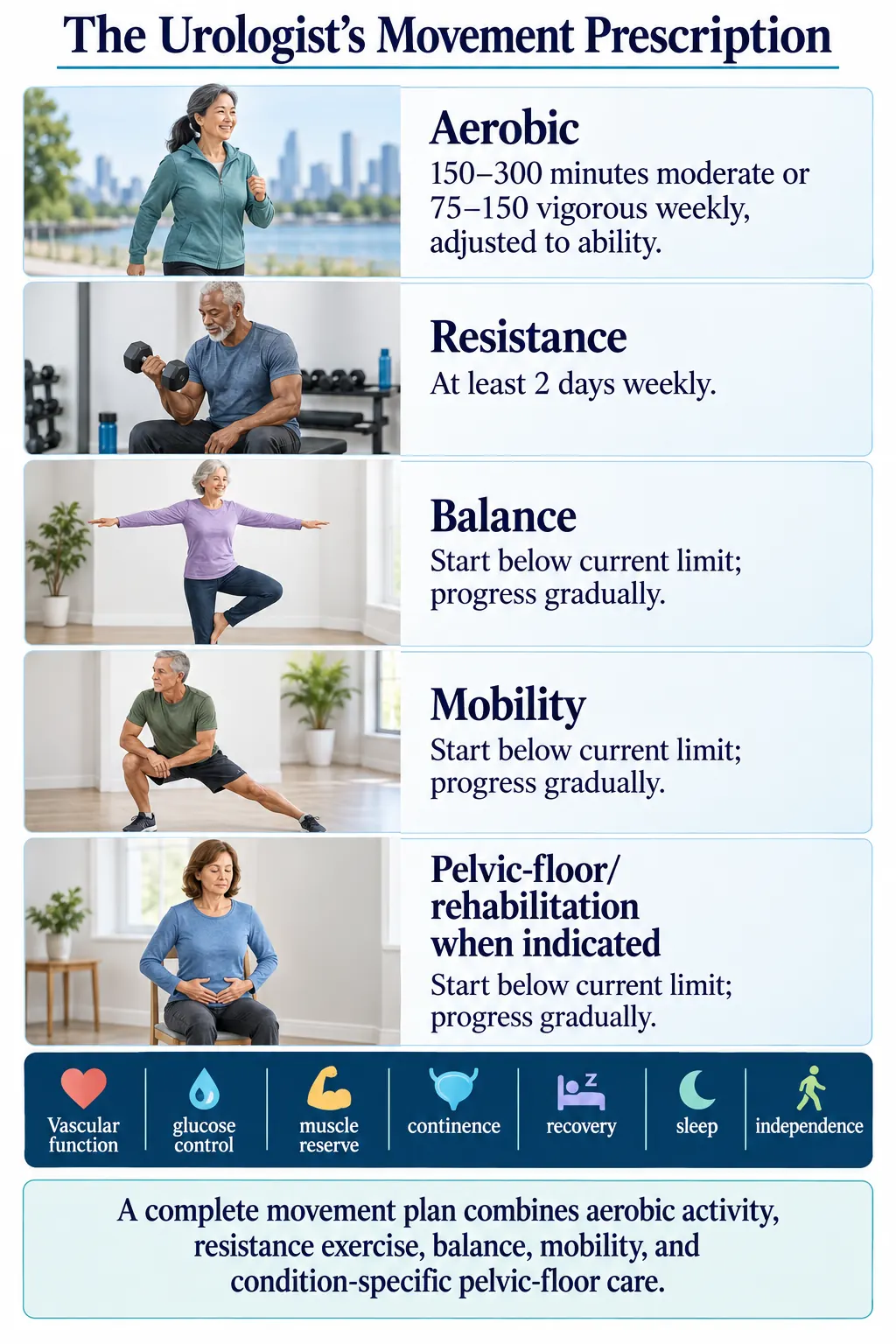
- A complete plan combines aerobic activity, strength, balance and mobility, plus pelvic-floor care when indicated.
- Public-health targets are destinations, not entry requirements; short, repeated sessions can be the right start.
- Pelvic-floor exercises should follow assessment, because excess tension needs relaxation, not more squeezing.
- Leakage with running or jumping does not mean exercise must stop for good.
- Exercise does not remove an obstruction or replace treatment for cancer or infection.
- Measure function, such as chair rises, stairs and walking speed, not just minutes.
Movement treats more than weight
Exercise protects vascular, metabolic, muscle, bone, mood and sexual health. It improves the circulation, strength, balance, sleep and functional independence on which urinary and sexual health depend.
- Aerobic activity improves cardiovascular fitness and the health of blood-vessel linings.
- Resistance training preserves strength and lean tissue.
- Balance and mobility work reduce the risk of falls, which matters especially for an older person rushing to the bathroom at night.
- Pelvic-floor rehabilitation addresses a specific muscle system when it is indicated.
- Ordinary walking breaks up prolonged sitting and supports glucose control.
What exercise can and cannot do
Physical activity supports general health and may improve erectile function. Condition-specific rehabilitation, including appropriately selected pelvic-floor training, can address particular functional problems. These are different interventions, and a general exercise program should not be assumed to treat every urinary symptom or improve every surgical outcome. Exercise does not mechanically remove an obstruction or replace treatment for cancer or infection.
Pelvic-floor exercises in particular should follow an assessment. If the muscles are overly tense rather than weak, they need relaxation and coordination, not more squeezing.
Dose has four parts
An exercise prescription includes frequency, intensity, duration and type. “Exercise more” leaves all four undefined. You might walk every day but never challenge your strength. You might train hard on weekends while staying sedentary during the week. You might train hard yet skip balance work despite recent falls.
Public-health targets provide a useful destination for many adults, including regular moderate or vigorous aerobic activity and muscle strengthening on at least two days each week. They are destinations, not entry requirements. Your starting dose must reflect your current capacity. Five or ten minutes repeated consistently can be more therapeutic than a plan so ambitious that pain, fear or exhaustion ends it within a week. A sedentary or medically complex person may begin with short walks, chair-based strength exercises, supervised rehabilitation or movement after meals. You do not have to wait until you feel fit enough to begin.
Progress by changing one variable at a time: first add days, then duration, then intensity. Resistance training can begin with body weight, bands, machines, free weights or supervised rehabilitation. The best equipment is whatever you can use safely, progress and sustain.
Modify the plan around urologic symptoms
Stress leakage during jumping or running does not mean exercise should stop permanently. It may mean adjusting impact, emptying your bladder beforehand, using a continence product for a while, addressing pelvic-floor coordination and rebuilding capacity. Pelvic pain may call for relaxation and gradual exposure rather than bracing through symptoms.
Pain, leakage, a catheter, recent surgery, heart disease, severe prolapse or active stone symptoms may all require changes. After surgery, the timeline depends on the operation, healing, catheter status, bleeding risk, the wound and your surgeon’s restrictions. Stone pain, fever, visible blood in the urine, sudden inability to urinate, unstable heart symptoms and severe dehydration change the plan. Exercise is preventive medicine only when the immediate situation is safe. If you have pelvic-floor problems, a heart condition, cancer or a recent procedure, ask whether you need specific guidance before you start.
Measure function, not just minutes
Useful outcomes include walking speed, how well you tolerate stairs, how easily you rise from a chair, confidence in your balance, the resistance you can use, symptoms during activity and how quickly you recover afterward. You may show meaningful progress before your weight changes at all.
Those gains have real consequences. They can determine whether you reach a toilet safely at night, tolerate cancer treatment or return home independently after a procedure. Train for the life you want to keep: climbing stairs, getting up off the floor, carrying groceries, recovering from a procedure and reaching the bathroom safely. Those are medical outcomes.
Building reserve
The correct starting dose is the one you can perform safely and repeat. Leakage, pelvic pain, a recent procedure, frailty or cancer treatment may change the form of exercise without removing movement from the plan. Exercise supports urologic care alongside diagnosis and any necessary treatment, not instead of it. Its most important effect may be on muscle itself, not for appearance but as metabolic reserve and protection against frailty. Choose one strength or function measure, such as how many times you can rise from a chair, and repeat it every few weeks to see whether your plan is working.
Questions to ask your urologist
- Which activities are safe for my current condition or stage of recovery?
- Do I need pelvic-floor, cardiac, cancer or rehabilitation guidance before starting?
- Should my pelvic-floor work focus on strengthening or relaxation?
- How should I adjust exercise if I leak during impact activities?
- Which strength or function measure should we use to see whether the plan is helping?