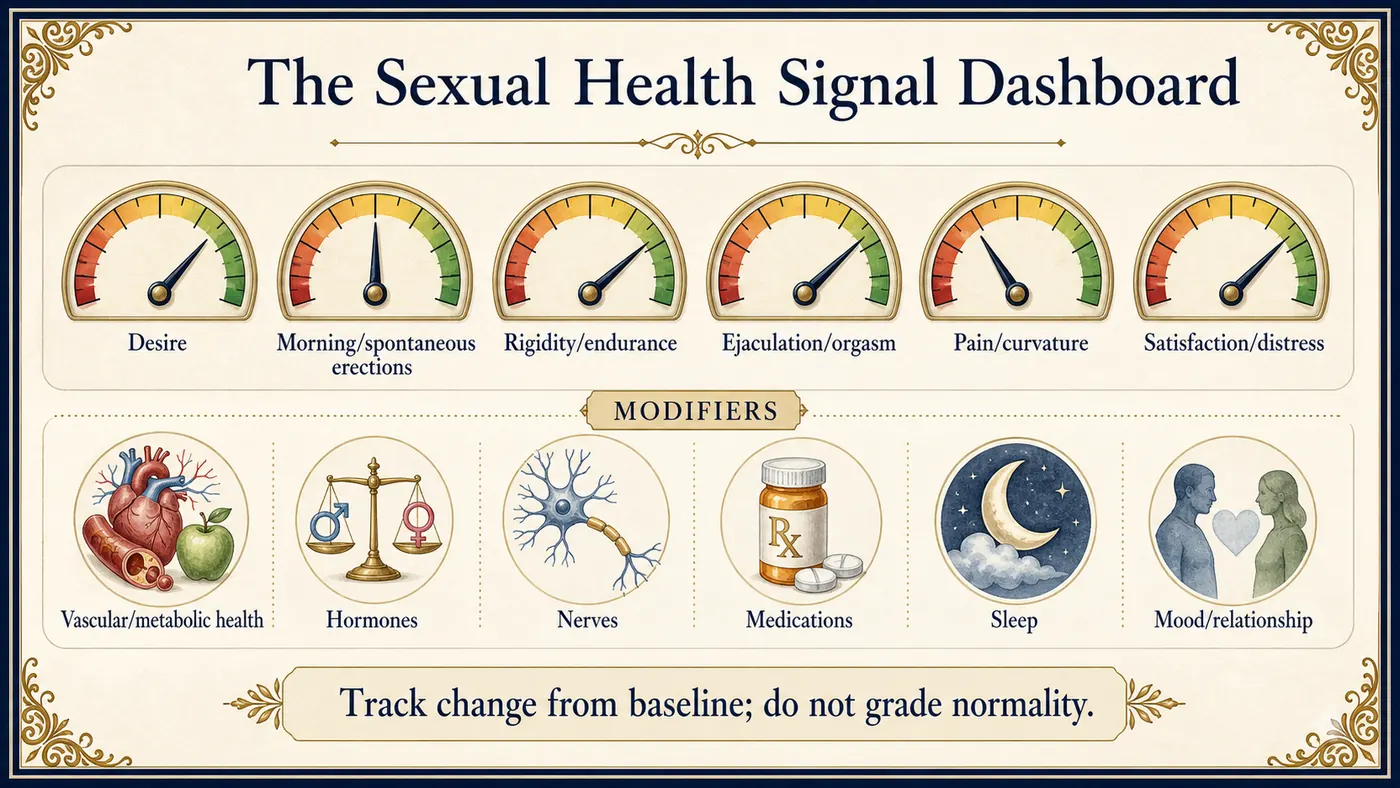
Key points
- Sexual function reflects many body systems; it is not a measure of your worth or of your relationship.
- What matters is change from your own baseline, not meeting a frequency or performance standard.
- Desire, arousal, erection, lubrication, ejaculation, orgasm, pain, curvature, sensation and satisfaction are separate domains.
- One disappointing encounter differs from a progressive decline across months and settings.
- Recording function before surgery or cancer treatment makes later change measurable.
- A good clinician asks without assuming a partner, orientation or type of sexual activity.
A trend worth asking about
Sexual function is not a traditional vital sign like blood pressure or pulse. Still, a meaningful change can reveal shifts in vascular, metabolic, hormonal, neurologic, medication-related, sleep or psychological health. Calling it a vital sign is a teaching idea, not a demand for a universal screening score. It is a reminder that intimacy and physiology belong in health care, and that silence can hide treatable disease.
Sexual function is also not a measure of your worth or of the quality of a relationship. If a change matters to you, it deserves care in its own right because it affects your quality of life, and it may offer clues about the rest of your health.
Your baseline is the reference point
Morning erections, desire, rigidity, ejaculation, orgasm, pain and satisfaction each describe different systems. Their value lies in how they change from your own baseline and in the context around that change, not in forcing everyone to meet one frequency or performance standard. A variation that causes no distress and does not limit anything you value may need only education, not treatment.
Ask without assuming
Many people never mention sexual concerns unless invited. A good clinician opens the subject without assuming you have a partner, a particular sexual practice, a particular orientation, penetrative intercourse, or that sex is important to you at all. A neutral question, such as whether you have noticed any change in sexual function that matters to you, gives permission without turning screening into pressure.
Intimacy itself is broader than erection or penetration. It can include touch, closeness, desire, communication, solitary sexual function, new relationships and adapted practices. The clinical goal is meaningful function as you define it.
Which domain changed?
If the answer is yes, the next question is which part changed. Desire, arousal, erection, lubrication, ejaculation, orgasm, pain, curvature, sensation and satisfaction are not interchangeable. Separating them often uncovers a medication effect, a tissue problem, an anxiety loop, a vascular pattern or a relationship concern that the phrase “sexual dysfunction” had hidden.
Context turns a trend into a signal
One disappointing encounter after stress, alcohol, conflict, poor sleep or illness is different from a progressive decline across months and settings. New erection difficulty in a man with diabetes and symptoms on exertion calls for a broader health review. A brief variation that causes no distress and resolves on its own may not.
The same sexual signal can carry different meanings. A gradual change in sexual response during a stressful year may improve with sleep, communication, exercise and treatment of pain or mood. A new change accompanied by chest pressure on exertion, uncontrolled diabetes or a neurologic symptom deserves a broader and more urgent review. The sexual symptom alone does not determine the answer.
What a change can lead to
The real value of treating sexual function as a vital sign is that it prompts a useful question: what else changed at the same time? Depending on the answer, a new decline may justify:
- a cardiovascular risk review
- a reconciliation of your medications
- a sleep assessment
- hormone testing, when indicated
- an examination for structural problems
- pelvic treatment, rehabilitation or counseling
- direct treatment of the sexual function itself
Good care does both at once: it works on improving the function that matters to you while investigating what the change may signal.
Set a baseline before major treatment
Before surgery or cancer therapy, recording how sexual function works now makes later change measurable and allows rehabilitation to begin earlier. Silence before treatment often becomes confusion afterward, because neither you nor your clinician knows what was present at the start. After surgery, radiation, menopause, neurologic disease or chronic pain, couples may wait for function to return on its own while avoidance becomes entrenched. Early education about expected changes, treatments, comfortable alternatives and when specialized counseling may help can protect connection.
Revisit the question
Sexual health changes as relationships, medications, menopause, hormones, heart health, disability and treatment evolve. A single “no” to a screening question should not close the subject forever. Reopening it respectfully can uncover a problem you were not ready to discuss before. Attention is warranted whenever a change causes distress, may signal disease, or limits a function you value.
Questions to ask your urologist
- Which part of my sexual function has changed, and since when?
- What else changed in my health, medications or sleep around the same time?
- Which whole-body risks deserve evaluation because of this change?
- Should we record my current function before my planned surgery or treatment?
- How can we treat the change itself while investigating what it may signal?